


December 1-4, 2026
Countdown
About SBMF 2026
The 29th Brazilian Symposium on Formal Methods (SBMF 2026) will be held in Rio de Janeiro, Brazil. SBMF is an established international forum for researchers and practitioners working on formal methods and their application to the specification, design, analysis, verification, and validation of high-quality computational systems. The symposium regularly attracts submissions and participants from institutions around the world.
The main topics discussed at SBMF include:
- ❖ Theoretical foundations: Formal aspects of specification languages, such as the development of new domain-specific languages, the formalization of existing languages, and the study of the foundations of software engineering.
- ❖ Systems development: Formal aspects of systems development, such as the application of formal methods to the development of cyber-physical systems, embedded systems, and software-intensive systems.
- ❖ Verification and validation: Formal verification of the correctness of software systems, the model checking of the requirements of software systems, and the fuzz testing of software systems.
- ❖ Neural networks: Formal verification of neural networks, such as the application of formal methods to the verification of the correctness of deep learning models.
- ❖ Practice: Self-formalization and formal aspects in practice, such as the automation of formal methods, the use of formal methods in industrial settings, and the teaching of formal methods.
Previous SBMF proceedings and event sites:
Program
| Time | Activity | Title / Description |
|---|---|---|
| Tuesday, 01 December 2026 Registration & Welcome | ||
| 09:00 - 18:00 | Registration | Registration desk open Cardeal Leme Building, PUC-Rio |
| Afternoon | City Tour (tentative) | Guided tour of Rio de Janeiro, details TBC |
| Wednesday, 02 December 2026 | ||
| 09:00 - 09:30 | Opening Ceremony | Welcome by General Chair and PC Chairs Edward Hermann Haeusler Genaína Nunes Rodrigues Pedro Ribeiro |
| 09:30 - 10:30 | Keynote | University of York, UK |
Efficient and effective testing of cyclic systems The RoboStar technology provides unique comprehensive support for design and verification of software for robots. The approach is model-centric: diagrams and (controlled) natural language are used to capture several aspects of a robotic system, and formal semantics, automatically generated, underpins techniques for simulation, proof, testing, and deployment. In this seminar, we present a practical model-based testing technique for RoboSim, the RoboStar notation that adopts the cyclic paradigm of simulations and of the cyclic executive programming pattern, for example. To enable generation of practical test sets, we use the timed testing theory for the process algebra CSP with inputs and outputs. We, however, for practical reasons, identify the test cases that become useless due to the specificities of cyclic mechanisms, and can be discarded. Secondly, we provide a technique to combine test cases, proving that soundness and completeness are preserved. Finally, we use the test cases to generate test drivers for C++ implementations of a collection of examples modelled in RoboSim. Our experiments show significant gains in efficiency. This state-of-the-art approach can significantly enhance the state-of-the-practice of testing in robotics. | ||
| 10:30 - 11:00 | Coffee Break | |
| 11:00 - 12:30 | Session 1 Mechanized Proofs and Language TheorySession Chair: To be assigned | |
| 11:00 - 11:30 | Paper presentation | |
Abstract Reasoning about the cost of a program is central to computer science, yet the operation counts behind a complexity bound are usually established informally. Resource-aware Hoare logics internalize this reasoning through cost-annotated triples {P} S {Q | t}, but their metatheory typically rests only on pen-and-paper proofs. In this work, we present a mechanization in Lean 4 of one such logic, covering its cost-instrumented semantics, its cost logic and its verification condition generator, together with a relative-completeness result absent from the source. The mechanization exposed two errors in the source, which we correct: an unsound while rule whose iteration bound is off by one, and a primitive for semantics inconsistent with the cost its own rule charges. We further add elementary asymptotic (O) cost assertions at the level of triples, as derivable weakenings of the concrete bounds, and use them on two examples. | ||
| 11:30 - 12:00 | Paper presentation | |
Abstract We present a machine-checked formalization, in the dependently typed language Agda, of the pumping lemma for context-free languages by the pushdown-automata route. A sufficiently long word accepted by empty stack drives the stack through a repeated configuration or to a great height, and in both cases the accepting computation is cut into segments that pump. The theorem is stated purely about an arbitrary pushdown automaton and its empty-stack language: grammars are never mentioned. Two ingredients are central: a normalization procedure which ensures that every step changes the stack height by one, preserving the whole language, the empty word included; and a well-founded recursion on the computation length that secures a non-empty pumped factor. | ||
| 12:00 - 12:30 | Paper presentation | |
Abstract The Greibach Normal Form (GNF) is a canonical form for context-free grammars in which every production begins with a terminal symbol. Converting an arbitrary grammar to GNF is a subtle process, which proceeds through a chain of transformations that eliminate -productions, unit rules, useless symbols, and left recursion before the final GNF step. Textbook presentations of this conversion usually argue its termination informally, leaving the underlying measure implicit. In this work, we present a formalization of the GNF conversion in which each stage carries a constructive proof that it preserves the language of the grammar it transforms. Composing these proofs yields an end-to-end theorem: every context-free grammar admits an equivalent grammar in Greibach Normal Form. All of our results are formalized using the Agda proof assistant. | ||
| 12:30 - 14:00 | Lunch Break | |
| 14:00 - 15:30 | Session 2 Proof Repair and Formal VerificationSession Chair: To be assigned | |
| 14:00 - 14:30 | Paper presentation | |
Abstract We address the use of large language models (LLMs) to help discover Isabelle proofs. An Isabelle build establishes that the submitted theory is accepted, but not that an LLM changed only what the developer authorised. We present CAPRI, a contract-aware repair workflow in which Isabelle checks the proof and an independent checker enforces a machine-readable edit contract. Prompts, proposals, candidate repositories, diagnostics, verdicts, and hashes are retained for audit. We evaluate five workflows on twelve failed proofs from four developments, with three replicates per task and condition, giving 180 runs and 138 valid repairs. Of 144 terminal candidates accepted by Isabelle, six had modified protected text; all arose in iterative workflows that could edit a complete theory. A proof-body-only interface produced 29/36 valid repairs and no contract violations, compared with 31/36 for the corresponding full-theory workflow. One-shot repair produced 22/36, while a later prospectively frozen iterative workflow produced 32/36; these figures compare complete workflows rather than individual mechanisms. | ||
| 14:30 - 15:00 | Paper presentation | |
Abstract Reachability games are a standard model for systems that must achieve a goal despite an uncooperative environment. Solving the game yields a winning strategy, and that strategy is deployed as the system's controller. Real systems, however, keep changing, and re-solving the game takes linear time in the size of the arena and produces a new controller while discarding one that is often still correct. We ask when a change preserves the strategy already in hand. A change is modelled as one of eight atomic edits, each carrying conditions on where it applies. These atomic changes can be composed to model a bigger change. For each edit we give a preservation test, in most cases a constant-time one. An edit may also break the strategy, either leaving it inapplicable, a syntactic break, or leaving it applicable but losing, a semantic break. We separate the two failures and repair syntactic breaks in constant time, apart from one case that is linear in the worst case, when a cheap repair exists. | ||
| 15:00 - 15:30 | Paper presentation | |
Abstract Contemporary RTL designs are inherently complex and, thus, they are increasingly difficult to validate and verify by simulation alone. Therefore, formal methods are typically employed to verify properties of interest, commonly represented as SystemVerilog Assertions (SVA). Many tools typically address the verification of SVA properties by employing solvers to analyse automata derived from SVA properties. However, due to the associated complexity and many domain-specific optimisations, it is not straightforward to demonstrate the correctness of such translation algorithms in general. In this work, we provide a foundational formalisation in the Rocq theorem prover of SVA expressions, waveforms (simulations), and automata for RTL design verification. Accompanied by domain-specific proof automation tactics we enable the construction of proof arguments regarding the semantic equivalence of SVA expressions and automata verification. Our contributions were validated considering an LLM-based pipeline, as well as a commercial tool (Xcelium). The developed automation tactics successfully discharged all valid proof goals. Tool support is also offered to translate waveforms and graphical representations of automata to our Rocq formalisation. | ||
| 15:30 - 16:00 | Coffee Break | |
| 16:00 - 17:30 | Session 3 Foundations and Formal SemanticsSession Chair: To be assigned | |
| 16:00 - 16:30 | Paper presentation | |
Abstract The Z property is a compact proof technique for confluence that has been used to give elegant confluence proofs for the -calculus and several of its extensions. Previous formalizations of the (compositional) Z property, as well as of the Substitution Lemma for calculi with explicit substitutions, were developed in Rocq. In this work, we recast this framework in a nominal setting, where variables are represented by atoms and binders are handled through name-swapping rather than de Bruijn indices, and formally verify it in the Rocq prover (version 9.1.1). As an application of this nominal framework, we formalize the x-calculus, an extension of the -calculus with explicit substitutions, and give a fully mechanized proof of its confluence via the compositional Z property. The whole development comprises around 4500 lines of Rocq code and 150 lemmas and theorems, and provides a reusable nominal toolkit for confluence proofs of calculi with explicit substitutions. | ||
| 16:30 - 17:00 | Paper presentation | |
Abstract Paraconsistent Labelled Transition Systems (PLTS) are structures in which transitions are weighted by a pair of values: one representing evidence in favour of the transition occurring and the other evidence against it. This framework naturally accommodates scenarios involving vague or inconsistent information, such as sensor-based control systems or medical decision-support systems based on conflicting examinations. While preserving contradictory information is often desirable at the modelling level, implementation and verification tasks ultimately require concrete bivalent outcomes. From this perspective, the expressive power of PLTS must be "tamed", bridging the gap between rich paraconsistent specifications and executable implementations. Motivated by such challenge, this paper introduces three forms of taming: at the level of truth values, models, and the satisfaction relation. We establish the relationships between these approaches and prove their equivalence for the diamond fragment of the modal logic. The proposed techniques have also been incorporated into the PLTS Toolkit, providing automated support for the corresponding modelling, design, and verification tasks. | ||
| 17:00 - 17:30 | Paper presentation | |
Abstract Program derivations calculate, via step-by-step reasoning, an algorithm which implements a given specification. In practice, however, the effectiveness of calculational methods depends on the mathematical language in which they are expressed, and known techniques tend to be verbose. As a way to make calculations more approachable and easier to discover, we study the application of a graphical language of string diagrams to the process of program derivation. By having diagrams represent feasibility relations, the notion of a Galois connection, which specifies functions as computing solutions to an optimization problem, becomes very simple to represent. This enables elegant point-free specifications, as well as proofs and program derivations that are built step-by-step from equalities between diagrams. We discuss how to represent derivational techniques graphically, and propose a novel point-free induction principle suited for string diagrams. For graphical induction we need to encode additional typing information in the diagrams, which we represent using colored wires. Finally, we showcase the methodology by deriving correct-by-construction recursive algorithms for problems on natural numbers and lists. | ||
| Thursday, 03 December 2026 | ||
| 09:00 - 10:00 | Session 4 Impact of Formal Methods in BrazilSession Chair: Leopoldo Teixeira (UFPE) TBC | |
| 09:00 - 09:30 | Invited talk | The Past, Present, and Future of Formal Methods in Brazil |
| 09:30 - 10:00 | Award | MIP Award |
| 10:00 - 10:30 | Coffee Break | |
| 10:30 - 11:30 | Session 5 Tooling for Cyber-Physical SystemsSession Chair: To be assigned | |
| 10:30 - 11:00 | Paper presentation | |
Abstract SysML v2 was designed with formal, executable semantics grounded in the Kernel Modeling Language (KerML), yet current tooling, including the official Pilot Implementation, provides no native engine to execute or verify these semantics, limiting engineers to static model authoring and leaving dynamic behavior unverified. Existing verification approaches close this gap by translating SysML v2 models into external formalisms, a strategy that introduces semantic gaps, proof obligations, and diagnostic results disconnected from the original model. This paper presents a translation-free approach to model checking SysML v2 actions, built on the Gmin framework, in which a Semantic Language Interface exposes a model's execution semantics directly as a transition system that the OBP verification engine explores without any intermediate transformation. We describe a proof-of-concept Java prototype that integrates the SysML v2 Pilot Implementation's parser with the OBP3 verification engine, which supports property specification in the Generic Property Specification Language over Linear Temporal Logic. We evaluate the approach on two case studies: a battery-charging system, in which a safety property violation is detected and traced directly to the responsible action, and a Close Air Support mission model, in which a structural defect causes a deadlock that is detected as a liveness property violation. Both cases demonstrate that counterexamples map directly onto the original SysML v2 elements, enabling engineers to reason about verification failures without artifacts introduced by translation. | ||
| 11:00 - 11:30 | Paper presentation | |
Abstract Formal verification is crucial for ensuring the safety of autonomous vehicles, yet a significant gap remains between abstract spatial logics and executable, trainable environments. In this paper, we bridge this gap by introducing an extensive toolkit that operationalises Urban Multi-Lane Spatial Logic (UMLSL). We present two new tools, UMLSL-Edit and UMLSL-Sim. UMLSL-Edit is a visual traffic editor and satisfaction checker for UMLSL, enabling (i) generation of traffic scenarios with an arbitrary number of roads, intersections, and cars, (ii) formulation of UMLSL queries, and (iii) deciding whether a traffic scenario satisfies these queries, by a procedure we prove sound and, on a delimited fragment, complete. Scenarios created in UMLSL-Edit can be used as an input for UMLSL-Sim, a traffic simulation tool in which cars drive according to implementations of timed-automata-based traffic controllers that were proven safe, in the abstract model, in prior work. UMLSL-Sim is developed as a Gymnasium environment with a Reinforcement Learning (RL) implementation, allowing the user to (i) train RL agents whose reward is shaped by the safety controller, so that actions the controller rejects are penalised, (ii) set up different reward profiles to optimise training for different objectives, and (iii) observe how the RL agents respond to different scenarios created in UMLSL-Edit. The toolkit is open source and available on Github. | ||
| 11:30 - 14:00 | Lunch Break | |
| 14:00 - 15:30 | Industrial PanelSession Chair: Moderator: To be assigned | |
| 14:00 - 14:30 | Paper presentation | |
Abstract Railway signalling systems are configured for each railway line by large volumes of constant data describing the track topology, the position of signals and switches, and the speed profiles. This data is as safety-critical as the certified software it parameterises: a single incorrect value can lead otherwise correct software to make an unsafe decision. Validating it has traditionally relied on cross-checking the configuration against reference track plans and regulations, an iterative activity that is slow, costly, inherently incomplete, and that must be repeated whenever the data changes. This paper reports on twenty years of industrial experience, at CLEARSY, with an alternative approach: formal data validation. The safety and consistency requirements that the data must satisfy are captured as a formal model in the mathematical language of the B method, and the conformance of the actual data against this model is then verified automatically, today by the ProB model checker, which either confirms a requirement over the whole data set or refutes it with an explicit counterexample. We retrace the evolution of the supporting tooling, from the early PredicateB evaluator to the ProB-based CLEARSY Data Solver and CLEARSY Data Manager; we describe the layered rule language built on accessors, intermediate constructs, and rules; and we discuss how the approach supports compliance with the railway safety standards, recalling that a national accident investigation bureau has explicitly recommended the use of formal methods for the validation of configuration data following an over-speed incident. | ||
| 14:30 - 15:30 | Panel Discussion | Open discussion on industrial applications of formal methods Panellists: TBC |
| 15:30 - 16:00 | Coffee Break | |
| 16:30 - 17:30 | Steering Committee | Business Meeting open to all attendees |
| 17:30 onwards | Social Activity | Details TBC |
| Friday, 04 December 2026 | ||
| 09:00 - 10:00 | Keynote | Amazon Web Services & Imperial College London |
A Formal Methods RenAIssance: AI, Trust, and What Is Worth Proving As AI agents take on more of the work of writing software, the questions of what to build and how to trust it become more pressing. The same technologies are also changing formal methods: they can propose invariants, guide proof search, and help construct machine-checked proofs, reducing some of the effort that has traditionally required specialist expertise. Meanwhile, greater reliance on generated code and the prospect of cheaper, more scalable attacks strengthen the case for rigorous assurance. This talk explores the opportunity created by these changes. Drawing on recent research and experiences at Amazon, we will examine how AI and formal methods can reinforce each other: AI helps produce candidate solutions and proofs, while formal tools provide precise feedback and checkable guarantees. The central question is what becomes most valuable as proof construction becomes more automated. A checked proof establishes a particular claim under particular assumptions; choosing that claim, validating those assumptions, and connecting them to the intended system remain essential. I will argue that this creates new opportunities for formal-methods experts to identify what is necessary and worth proving, develop useful abstractions, and build sound tools that agents can use. This also raises a challenge for education: how do we cultivate the judgment and understanding on which trustworthy automation depends? | ||
| 10:00 - 10:30 | Coffee Break | |
| 10:30 - 11:30 | Session 6 Strategic Reasoning and Multi-Agent SystemsSession Chair: To be assigned | |
| 10:30 - 11:00 | Paper presentation | |
Abstract The Dining Philosophers is a well-studied model that demonstrates basic challenges in concurrent programming, as well as resource allocation in multi-agent environments. Generalisations of the Dining Philosophers have been proposed that constitute generic multi-agent resource allocation (MRA) models, however, only fully deterministic generalisations are typically considered, limiting the models' applicability to real-world distributed systems in which randomness occurs. We enhance a Generalised Dining Philosophers game model to incorporate random resource failures, developing a framework for modelling practical competitive resource allocation problems that involve probabilistic uncertainty. Strategy synthesis in the context of multi-player games is a technique whereby strategy profiles are constructed that, if followed by agents, can guarantee a specified desirable outcome or assertion. We implement an approach that uses PRISM-games, a probabilistic model checker, to synthesise strategies that meet optimality criteria or achieve a game equilibrium for the formulated Stochastic Generalised Dining Philosophers (SGDP) game. Furthermore, we describe symmetry in the SGDP game model and demonstrate the exploitation of symmetry arguments in reasoning about expected agent outcomes. | ||
| 11:00 - 11:30 | Paper presentation | |
Abstract We develop a counterexample-guided abstraction refinement (CEGAR) approach for Nash equilibrium (NE) synthesis in region-control multi-agent systems (RCMAS). An RCMAS models agents competing to occupy sectors of a shared territory, with rewards based on cohesive region size. The SMT-based synthesis approach introduced in prior work does not scale well, as the search space grows rapidly with the size of the territory. Our new approach addresses this by merging sectors into weighted blocks via a territory partition, inducing a smaller abstract RCMAS on which synthesis becomes more efficient. A candidate NE is synthesised on the abstract instance, lifted to the concrete system, and verified; if a profitable deviation is found, this shows that the candidate NE is spurious. The deviation serves as a counterexample, which drives targeted partition refinement. We prove soundness and termination of the refinement loop, with a linear upper bound on the number of refinement iterations in the size of the territory. Experiments on grid territories confirm consistent speedups over direct synthesis and enable Nash equilibrium synthesis for instances previously intractable. | ||
| 11:30 - 12:30 | Closing Ceremony | Closing remarks Best paper award Announcement of SBMF 2027 |
Scope and Topics
SBMF aims to provide a venue for the presentation and discussion of high-quality work in formal methods. The topics include, but are not limited to, the following:
Applications of formal methods
- ▪ Software or hardware design
- ▪ Software or hardware development
- ▪ Software or hardware code generation
- ▪ Software or hardware testing
- ▪ Software maintenance, evolution and reuse
- ▪ Intelligent systems
Specification & modeling languages
- ▪ Logic and semantics for specification and programming languages
- ▪ Formal methods for timed, real-time, hybrid, or safety-critical systems
- ▪ Formal methods for service-oriented, cloud-based, or cyber-physical systems
Theoretical foundations
- ▪ Domain theory
- ▪ Term rewriting
- ▪ Computational models
- ▪ Type systems and category theory
- ▪ Computational complexity of methods and models
- ▪ Models of time, concurrency, security, and mobility
Verification and validation
- ▪ Abstraction, modularization, and refinement techniques
- ▪ Static analysis
- ▪ Model checking
- ▪ Theorem proving
- ▪ Software certification
- ▪ Correctness by construction
Experience reports
- ▪ Reports on teaching formal methods
- ▪ Reports on the industrial application of formal methods
Important Dates
Mark your calendars. All deadlines are Anywhere on Earth (AoE).
Paper registration deadline
July 31st, 2026 ExtendedAugust 14th, 2026Paper submission deadline
August 7th, 2026 ExtendedAugust 14th, 2026Acceptance notification
September 25th, 2026Camera-ready deadline
October 23th, 2026SBMF 2026
December 1st to 4th, 2026
Registration
Please carefully read the information below to know the conditions and deadlines. All registration fees are in Brazilian reais (R$/BRL).
- ** Conference Dinner included.
| Category | SBMF | SBMF + SBC |
|---|---|---|
| Period: 19/Sep - 26/Oct ***NEW REGISTRATION DEADLINE*** | ||
| Undergraduate Student – SBC Member | R$ 50,00 | R$ 83,00 |
| Undergraduate Student – non SBC Member | R$ 88,00 | R$ 83,00 |
| Graduate Student – SBC Member | R$ 110,00 | R$ 245,00 |
| Graduate Student – non SBC Member | R$ 256,00 | R$ 245,00 |
| Basic Education Teacher – SBC Member | R$ 165,00 | R$ 300,00 |
| Basic Education Teacher – non SBC Member | R$ 317,00 | R$ 300,00 |
| Federal Education Teacher – SBC Member | R$ 175,00 | R$ 545,00 |
| Federal Education Teacher – non SBC Member | R$ 563,00 | R$ 545,00 |
| Professional – SBC Member | R$ 200,00** | R$ 575,00** |
| Professional – non SBC Member | R$ 595,00** | R$ 575,00** |
| Period: 27/Oct - 23/Nov | ||
| Undergraduate Student – SBC Member | R$ 60,00 | R$ 93,00 |
| Undergraduate Student – non SBC Member | R$ 99,00 | R$ 93,00 |
| Graduate Student – SBC Member | R$ 140,00 | R$ 275,00 |
| Graduate Student – non SBC Member | R$ 289,00 | R$ 275,00 |
| Basic Education Teacher – SBC Member | R$ 190,00 | R$ 325,00 |
| Basic Education Teacher – non SBC Member | R$ 344,00 | R$ 325,00 |
| Federal Education Teacher – SBC Member | R$ 200,00 | R$ 570,00 |
| Federal Education Teacher – non SBC Member | R$ 590,00 | R$ 570,00 |
| Professional – SBC Member | R$ 220,00** | R$ 595,00** |
| Professional – non SBC Member | R$ 617,00** | R$ 595,00** |
| Period: 24/Nov - 05/Dec | ||
| Undergraduate Student – SBC Member | R$ 70,00 | R$ 103,00 |
| Undergraduate Student – non SBC Member | R$ 110,00 | R$ 103,00 |
| Graduate Student – SBC Member | R$ 160,00 | R$ 295,00 |
| Graduate Student – non SBC Member | R$ 311,00 | R$ 295,00 |
| Basic Education Teacher – SBC Member | R$ 200,00 | R$ 335,00 |
| Basic Education Teacher – non SBC Member | R$ 355,00 | R$ 335,00 |
| Federal Education Teacher – SBC Member | R$ 210,00 | R$ 580,00 |
| Federal Education Teacher – non SBC Member | R$ 601,00 | R$ 580,00 |
| Professional – SBC Member | R$ 240,00** | R$ 615,00** |
| Professional – non SBC Member | R$ 639,00** | R$ 615,00** |
Registration is on!
Register Now via SBC ECOS!PROMOTIONAL REGISTRATION
Non-SBC members or members with an annual fee that is about to expire can join or renew their membership along with their registration, choosing the COMBO categories with a discount on the registration fee.
The COMBO categories are the most advantageous option for non-SBC members, as the registration fees are lower than the categories without combo and include SBC membership.
Becoming a member of SBC is a way to make SBC even stronger to represent our area of work with the various sectors. How about becoming part of our Community?
Some exclusive member benefits:
PAYMENT METHODS
Payment of enrollments can be made by means of bank slip, credit card, debit in Banco do Brasil account, purchase order or invoice.
Enrollments can be made until the last day of the event, however payments by debit and bill will be accepted until November 28th, 2026.
Enrollments by purchase order or invoice:
The participant must access the enrollment system and register, selecting the payment method "purchase order" or "invoice" and clicking on pay. The system will provide the information necessary for the enrollment to be confirmed.
ENROLLMENT FOR AUTHORS
Registration for SBMF authors. Papers accepted to SBMF will be published in a volume of LNCS. At least one author (professional or student) of each accepted paper must be registered for SBMF 2026. Authors can not use the registration benefits (exemption or 50% discount) granted by SBC to affiliated institutions. The author registration must be paid until October 26th, 2026.
CANCELLATION POLICY
Until November 16th, 2026, a refund of 50% of the registration fee for SBMF may be requested. After this date, no refunds will be issued. This policy applies both to the cancellation of the registration itself and to the cancellation of any additional activities. To request a cancellation, please send your request to faturamento@sbc.org.br.
Speakers
Special Talks
Meet our distinguished invited speakers for SBMF 2026.
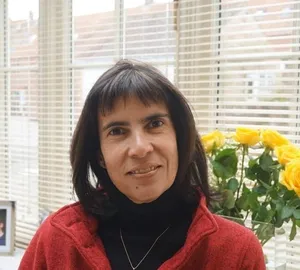
Prof. Ana Cavalcanti
University of York, UK
Efficient and effective testing of cyclic systems
About the speaker
Ana Cavalcanti is a Professor at the University of York, UK, and holds a Royal Academy of Engineering Chair in Emerging Technologies. In that role, she is Director of the RoboStar centre on Software Engineering for Robotics. She previously held a Royal Society Industry Fellowship, which provided her with the ideal opportunity to understand and contribute to the practice of formal methods working with QinetiQ. Her main scientific achievements have been on the design and justification of sound refinement-based program development and verification techniques. She has covered theoretical and practical integration with industry-strength technology: concurrency, object-orientation, and testing, dealing now with mobile and autonomous robots. She has led the development and justification of refinement theories, notations, and techniques, and tools to cope with control systems. Her work provides support for graphical notations popular with engineers, and for main-stream programming languages. It is distinctive in that it has comprehensive coverage of practical languages, rather than idealised notations. It also supports high degrees of automation to enable usability and scalability. She has chaired the Programme Committee of leading conferences, and been a member of numerous Programme Committees. Currently, she is the Chair of the Formal Methods Europe Board.
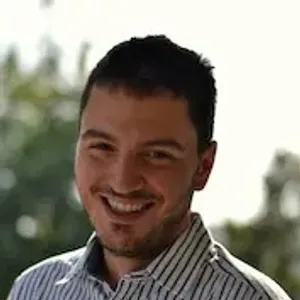
Prof. Antonio Filieri
Amazon Web Services and Imperial College London
A Formal Methods RenAIssance: AI, Trust, and What Is Worth Proving
About the speaker
Antonio Filieri is a Principal Applied Scientist at Amazon Web Services and an Honorary Associate Professor of Software Engineering at Imperial College London, where he was previously a tenured Associate Professor. His current work focuses on neuro-symbolic methods for software engineering, integrating language-model agents with formal verification and testing to generate and refine code and specifications. His broader research combines automated reasoning, probabilistic analysis, and control theory to develop mathematical methods and practical tools for secure, dependable software. A central theme is understanding software behavior under uncertainty and using that understanding to guide verification and adaptation. At AWS, he applies these methods to cloud security and data integrity, including the synthesis and verification of cloud security controls.
Committees
Organizing Committee
General Chair
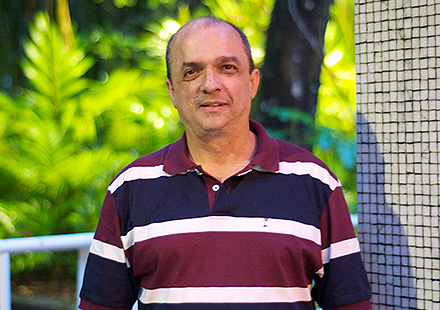
Edward Hermann Haeusler
Pontifícia Universidade Católica do Rio de Janeiro, Brazil
PC Chairs

Genaína Nunes Rodrigues
Universidade de Brasília, Brazil
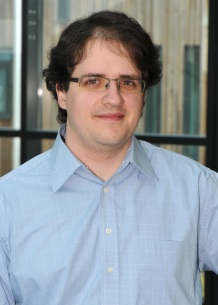
Pedro Ribeiro
University of York, UK
Steering Committee
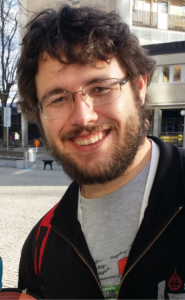
Haniel Barbosa
Universidade Federal de Minas Gerais, Brazil

Maurice ter Beek
CNR-ISTI, Italy
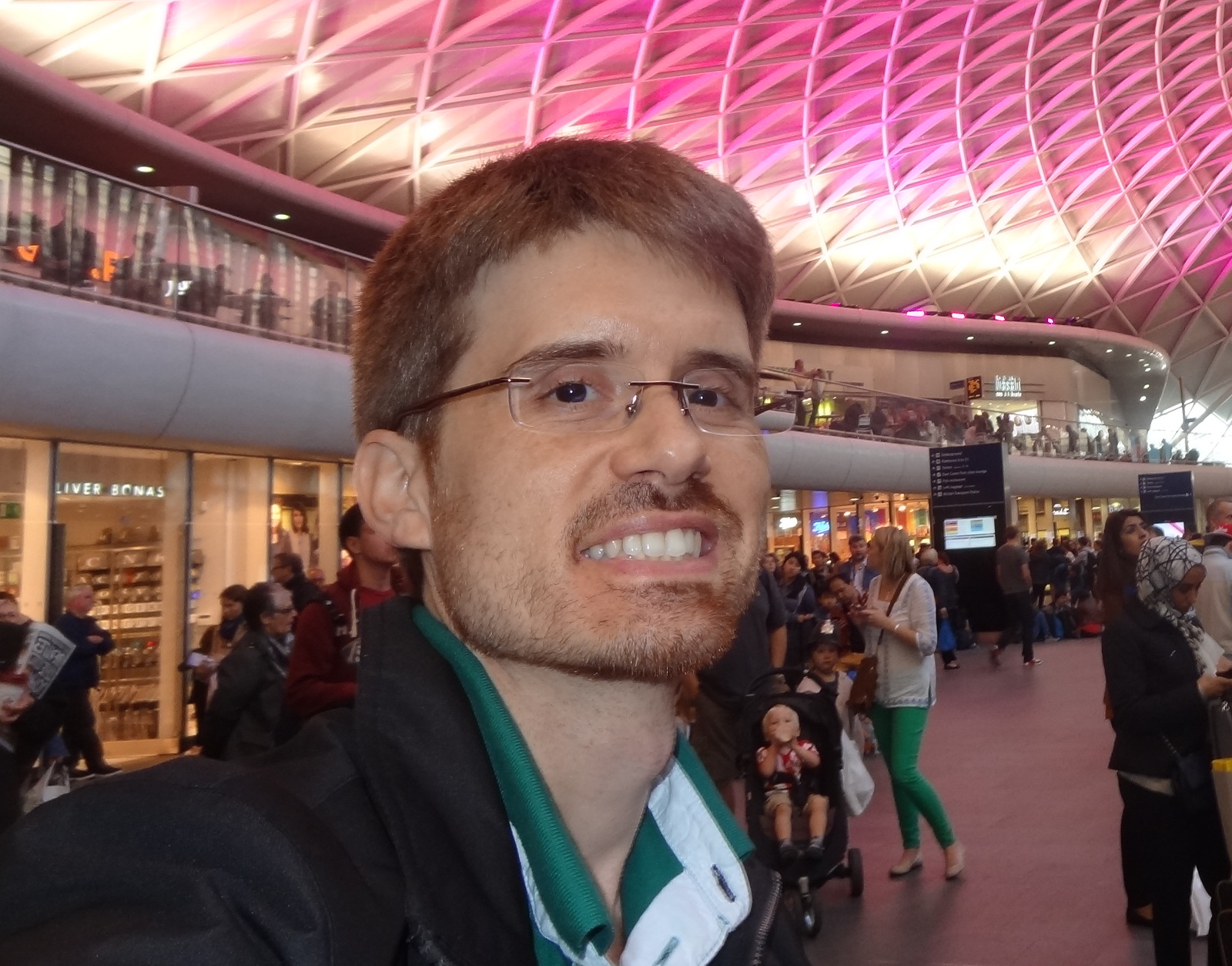
Sidney Nogueira
Universidade Federal Rural de Pernambuco, Brazil
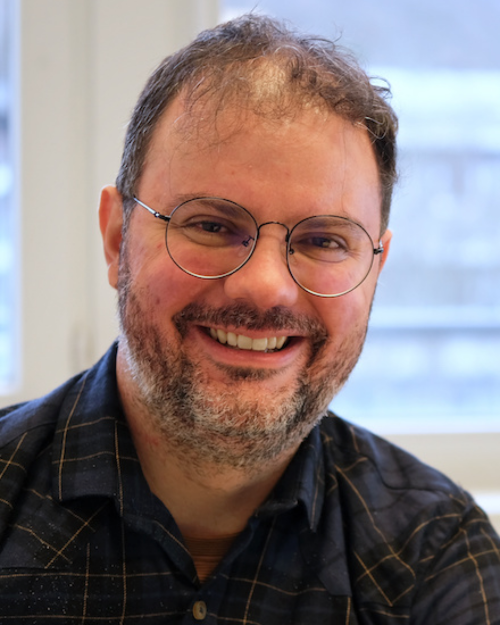
Leopoldo Teixeira
Universidade Federal de Pernambuco, Brazil
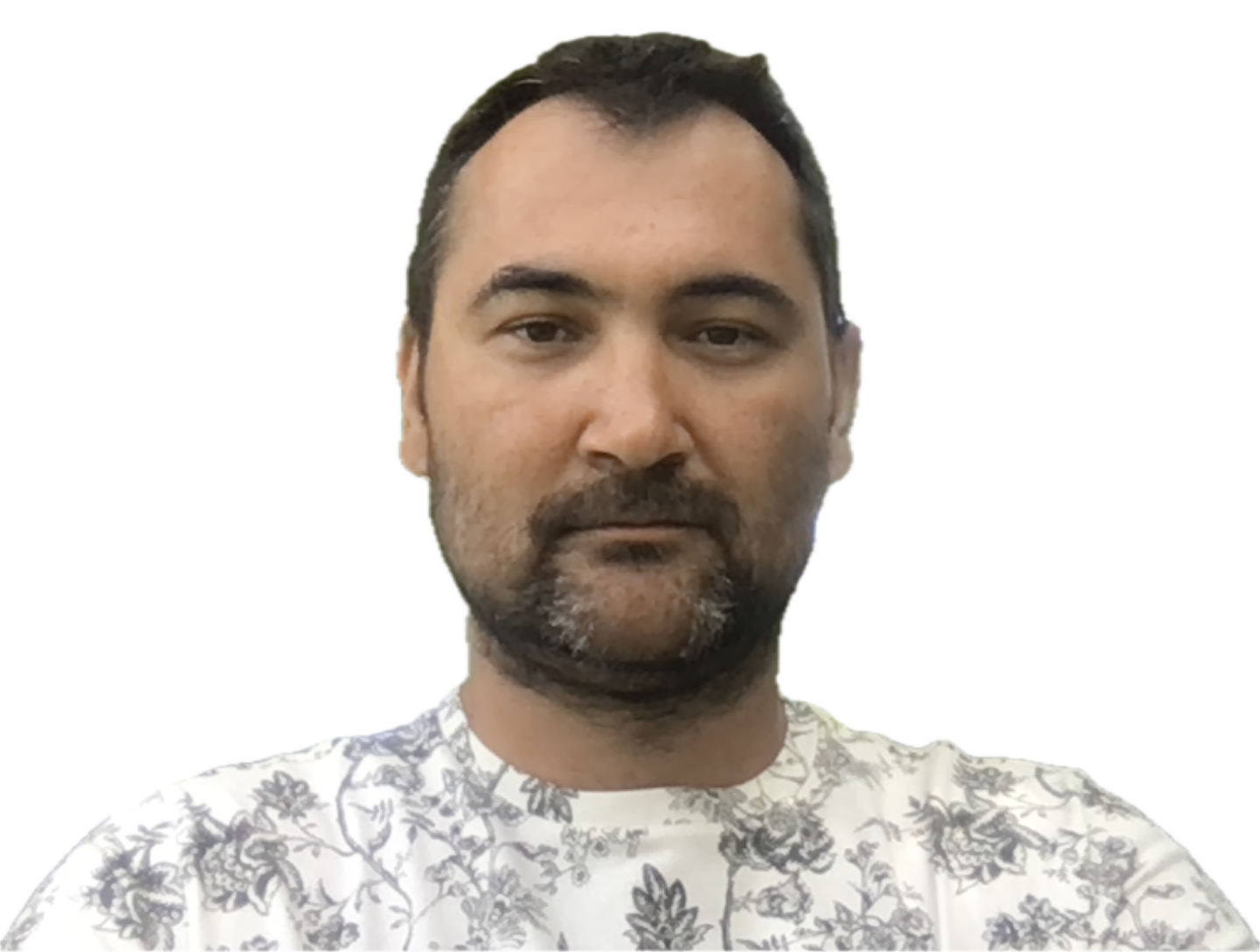
Ciprian Teodorov
ENSTA Bretagne, France

Yoni Zohar
Bar-Ilan University, Israel
Web Chair

Renato Paiva
Universidade de Brasília, Brazil
Contact the organizing committee at
sbmf2026@easychair.orgProgram Committee
- ❖
Jefferson O. Andrade
Instituto Federal do Espírito Santo, Brazil
- ❖
Haniel Barbosa
Universidade Federal de Minas Gerais, Brazil
- ❖
Luís Soares Barbosa
Universidade do Minho; INESC TEC; UNU-EGOV, Portugal
- ❖
Davide Basile
Formal Methods & Tools; ISTI-CNR, Italy
- ❖
Armin Biere
University of Freiburg, Germany
- ❖
Silvia Bonfanti
University of Bergamo, Italy
- ❖
Gustavo Carvalho
Universidade Federal de Pernambuco, Brazil
- ❖
Valentina Castiglioni
Eindhoven University of Technology, Netherlands
- ❖
Márcio Cornélio
Universidade Federal de Pernambuco, Brazil
- ❖
Chelsea Edmonds
University of Western Australia, Australia
- ❖
Katalin Fazekas
TU Wien, Austria
- ❖
Ahmed Irfan
SRI International, USA
- ❖
Juliano Iyoda
Universidade Federal de Pernambuco, Brazil
- ❖
Alberto Lluch Lafuente
Technical University of Denmark, Denmark
- ❖
Thierry Lecomte
CLEARSY, France
- ❖
Michael Leuschel
University of Düsseldorf, Germany
- ❖
Livia Lestingi
Politecnico di Milano, Italy
- ❖
Nianyu Li
ZGC National Laboratory, China
- ❖
Lucas Lima
Universidade Federal Rural de Pernambuco, Brazil
- ❖
Carlos Luna
Facultad de Ingeniería, Udelar, Uruguay
- ❖
Claudio Mandrioli
University of Luxembourg, Luxembourg
- ❖
Alexandra Mendes
University of Porto, Portugal
- ❖
Alvaro Miyazawa
University of York, United Kingdom
- ❖
Vince Molnár
Budapest University of Technology and Economics, Hungary
- ❖
Rosemary Monahan
National University of Ireland, Ireland
- ❖
Alexandre Mota
Universidade Federal de Pernambuco, Brazil
- ❖
Sidney Nogueira
Universidade Federal Rural de Pernambuco, Brazil
- ❖
Marcel Oliveira
Universidade Federal do Rio Grande do Norte, Brazil
- ❖
Luigia Petre
Åbo Akademi University, Finland
- ❖
Luciana Rebelo
Gran Sasso Science Institute, Italy
- ❖
Philipp Rümmer
University of Regensburg; Uppsala University, Germany/Sweden
- ❖
Augusto Sampaio
Universidade Federal de Pernambuco, Brazil
- ❖
Hans-Jörg Schurr
The University of Iowa, USA
- ❖
Maike Schwammberger
KIT, Germany
- ❖
Paola Spoletini
Kennesaw State University, USA
- ❖
Volker Stolz
Western Norway University of Applied Sciences, Norway
- ❖
Ciprian Teodorov
Ensta Bretagne - Lab-STICC MOCS, France
- ❖
Nils Timm
University of Pretoria, South Africa
- ❖
Jim Woodcock
University of York, United Kingdom
- ❖
Yoni Zohar
Bar-Ilan University, Israel
Submission Instructions
We invite submissions of papers with a strong emphasis on formal methods, whether practical or theoretical, in the following categories:
Regular papers
Max 15 PagesProofs of theoretical results that do not fit the page limit may be provided in an appendix.
Short papers
Max 8 PagesIncludes system descriptions, user experiences, and case studies. We encourage authors to make the data needed to reproduce their experiments available.
ℹ The page limits exclude references and appendices.
❖ Formatting & Guidelines
Contributions should not be simultaneously submitted for publication elsewhere. They should be written in English, and prepared using Springer’s Lecture Notes in Computer Science (LNCS) format.
Springer’s proceedings LaTeX templates are available in Overleaf.
View LNCS Guidelines →❖ Review Process
Papers should present unpublished and original work that has a clear contribution to the state-of-the-art on the theory and practice of formal methods.
Papers will be judged by at least three reviewers based on originality, relevance, technical soundness, and presentation quality. Industry papers should emphasize the practical application of formal methods or report on open challenges.
Publication
📚 Proceedings
We plan that accepted papers will be published, after the conference, in a volume of LNCS (Lecture Notes in Computer Science). The authors will be requested to complete and sign a consent-to-publish form.
⚠️ Mandatory Registration
Every accepted paper MUST have at least one author registered in the symposium by the time the camera-ready copy is submitted. The registered author is also expected to attend the symposium and present the paper.
To be confirmed: Special Issue
We plan to follow on last years' tradition of organizing a special issue of the Science of Computer Programming Journal (Elsevier) with selected and extended papers from the 29th Brazilian Symposium on Formal Methods (SBMF 2026).
Accepted Papers
The following papers have been accepted for SBMF 2026.
Data validation based on a formal specification of the safety requirements - 20 years of industrial experience
Thierry Lecomte, Dalay Almeida, Vincent Germain and Michael Leuschel
Strategy Synthesis in a Stochastic Generalised Dining Philosophers Game
Luke Lawson and Nils Timm
Counterexample-Guided Abstraction Refinement for Nash Equilibrium Synthesis in Region-Control Multi-Agent Systems
Steven Jordaan and Nils Timm
A Nominal Formalization of the Confluence of a Calculus with Explicit Substitutions via the Z Property
Flávio Leonardo Cavalcanti de Moura
CAPRI: Contract-Aware Proof Repair for Isabelle
Jim Woodcock, Gabriel Leite, Augusto Sampaio and Ran Wei
Towards a translation-free model checking approach for SysML v2 actions
Vitor Barros, Pedro Mesquita, Lucas Lima and Ciprian Teodorov
Preservation and Repair of Reachability Strategies in a Changing Game Arena
Shobhit Singh, Qais Hamarneh, Mattias Ulbrich and Maike Schwammberger
Edit, Check, Simulate and Train: A Toolkit for Urban Multi-lane Spatial Logic
Qais Hamarneh, Nils Wenninghoff, Akhila Bairy, Mattis Bihler, Florian Portscher, Tim Kreuch, Tao Schmidt and Maike Schwammberger
Mechanizing a Resource-Aware Hoare Logic with Asymptotic Cost Assertions in Lean
Gabriel Araújo Saldanha and Rodrigo Ribeiro
A Machine-Checked Formalization of the Pumping Lemma for Context-Free Languages via Pushdown Automata
Rodrigo Ribeiro
A Machine-Checked Formalization of the Greibach Normal Form Conversion for Context-Free Grammars
Rodrigo Ribeiro
Taming Paraconsistent Transition Semantics
Rodrigo Alves, Juliana Cunha and Alexandre Madeira
Mechanised Reasoning about SystemVerilog Assertions in Rocq
Felipe Santos, Matheus Fonseca and Gustavo Carvalho
Program Derivation with Relations, Crescents, Bendy Loops and Colored Wires
Gustavo Freire, Hugo Musso Gualandi, Hugo Nobrega and João Paixão
Venue
All SBMF 2026 activities will take place at the Auditório Pe. Anchieta, on the ground floor of the Cardeal Leme Building, at PUC-Rio (Pontifical Catholic University of Rio de Janeiro).
Open in Google MapsFor orientation on campus, please consult the PUC-Rio campus map below.
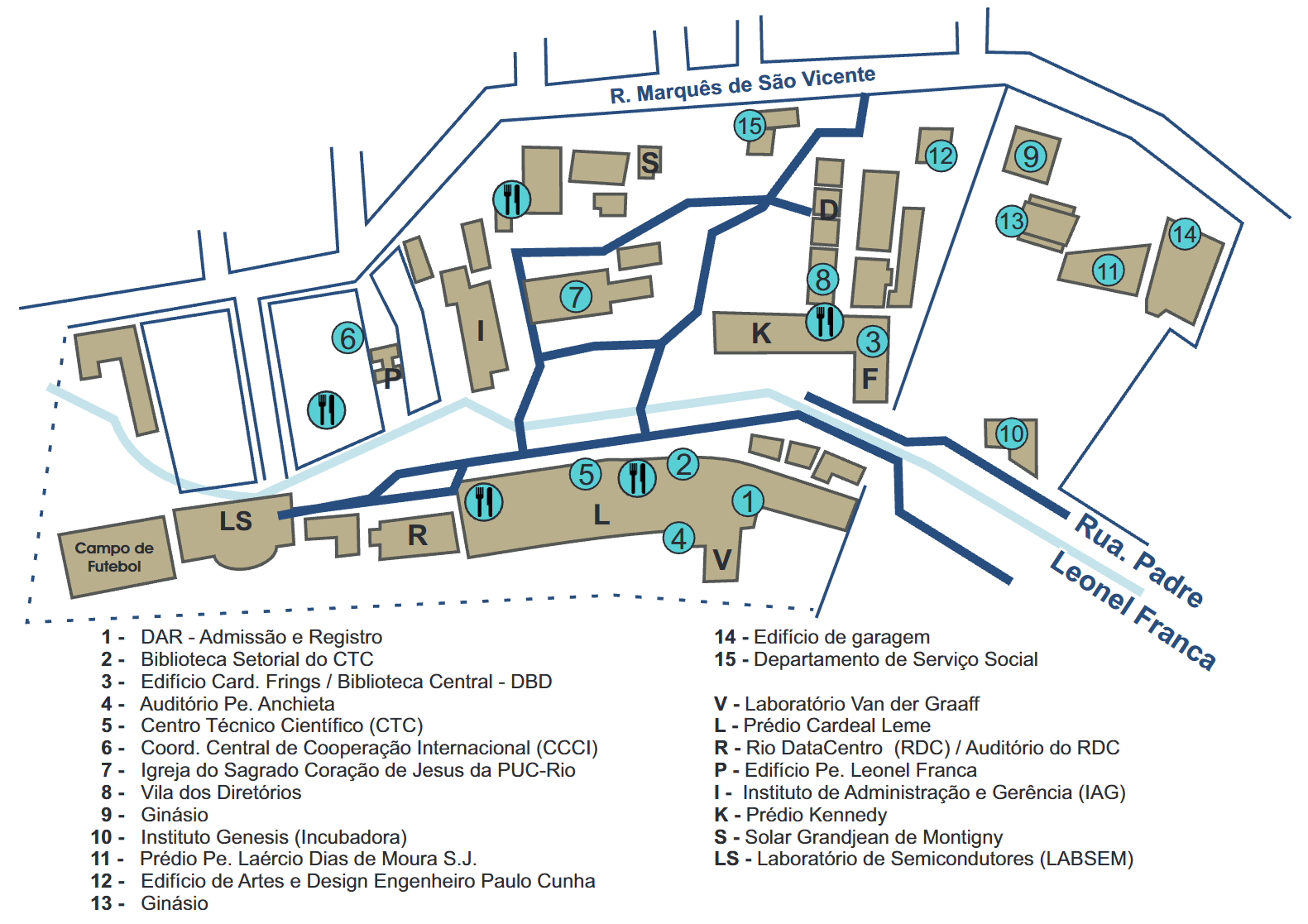
Click the map to view it in full size.
Accommodation
The hotels below have provided information for SBMF 2026 participants. Please contact each hotel directly to confirm rates, availability and booking conditions.
Botafogo
ibis Styles RJ Botafogo SBMF participant offer
Address: Rua São Clemente, 30 — Botafogo, Rio de Janeiro, RJ
Phone: (21) 3166-9240
Email: hb2z6-re@accor.com
Information: SBMF participants receive 15% off the public rate of the day through the booking link: https://all.accor.com/lien_externe.svlt?goto=rech_resa&destination=b2z6&sourceid=EVT15&dayIn=30&monthIn=11&yearIn=2026&nightNb=5&preferredCode=EVT15&merchantid=par-accorFR. For the quoted period, rates were R$ 549.00 single / R$ 609.00 double, including breakfast and 5% ISS; subject to change and availability.
Visit hotel websiteibis budget RJ Praia de Botafogo SBMF participant offer
Address: Praça Joia Valansi, 24 — Botafogo, Rio de Janeiro, RJ
Phone: (21) 2156-6999 (hotel); (21) 2187-9999 (reservations)
Email: h9600-re@accor.com
Information: SBMF participants can request 15% off the website rate for reservations including breakfast by giving the code SBMF15 to the reservations team. Valid from December 1 to 4, 2026; cannot be combined with other discounts and is subject to availability. Book directly with the hotel. Reservations service is available Monday to Friday, 8 a.m.–6 p.m.; please check applicable conditions for other dates.
Visit hotel websiteibis Rio de Janeiro Botafogo SBMF participant offer
Address: Rua Paulino Fernandes, 39 — Botafogo, Rio de Janeiro, RJ
Phone: (21) 3515-2999
Email: h7547-re@accor.com
Information: SBMF participants receive 10% off the public rate for stays from December 1 to 4, 2026, using coupon SBMF26 on bUP Plus. The booking link pre-fills the coupon: https://bupplus.com.br/?cupom=SBMF26. Rates are flexible and subject to availability. Up to two children under 16 may stay on a sofa bed in the parents’ room, subject to availability.
Visit hotel websiteNovotel RJ Praia de Botafogo SBMF participant offer
Address: Praia de Botafogo, 330 — Botafogo, Rio de Janeiro, RJ
Phone: (21) 2187-9999 (telephone and WhatsApp)
Email: h9631-re@accor.com
Information: SBMF participants receive 10% off the public rate with code SBMF10. Book directly with the hotel by email or WhatsApp and provide the code. Rates vary with the time of booking and reservations are subject to availability.
Visit hotel websiteCopacabana
Hotel Astoria Copacabana
Address: Rua República do Peru, 345 — Copacabana, Rio de Janeiro, RJ
Phone: (21) 2545-9090 (also WhatsApp)
Email: reservas@astoria.com.br
Information: Daily rates include breakfast served in the restaurant. Check-in from 2 p.m.; check-out until noon. Rates are variable and subject to availability.
Visit hotel websiteibis Copacabana Posto 5 SBMF participant offer
Address: Rua Xavier da Silveira, 82 — Copacabana, Rio de Janeiro, RJ
Phone: (21) 3721-2900
Email: h9361-re@accor.com.br
Information: The hotel offers 10% off the total reservation through the ALL Accor loyalty program. SBMF participants should contact the hotel directly to coordinate occupancy and bed configuration. Check rates with or without breakfast and prepayment conditions when booking.
Visit hotel websiteAtlantis Copacabana Hotel SBMF participant offer
Address: Rua Bulhões de Carvalho, 61 — Copacabana, Rio de Janeiro, RJ
Phone: (21) 2521-1142; (21) 99654-2636 (information WhatsApp)
Email: reservas@atlantishotel.com.br
Information: R$ 500.00 per night for a single room and R$ 600.00 for a double room, including breakfast. Request this rate directly by email or telephone and mention the SBMF event at PUC-Rio. Check-in from 3 p.m.; check-out until noon. Please confirm the double-room bed configuration when booking.
Visit hotel websiteHotel Atlântico Rio
Address: Rua Xavier da Silveira, 112 — Copacabana, Rio de Janeiro, RJ
Phone: (21) 2128-7000
Email: reservas@atlanticorio.com.br
Information: For further information, please contact the hotel directly.
Visit hotel websiteSouth American Copacabana SBMF participant offer
Address: Rua Francisco Sá, 90 — Copacabana, Rio de Janeiro, RJ
Phone: (21) 2227-9161; (21) 99518-7525 (WhatsApp)
Email: reservas@southamericanhotel.com.br
Information: SBMF participants may request 10% off quoted rates by providing code SBMF10 by email or WhatsApp. Reservations are subject to availability. Breakfast, Wi-Fi and in-room safe are included in the quoted rate, plus 5% ISS.
Visit hotel websiteNacional Inn Rio Copacabana (formerly Ibiza) SBMF participant offer
Address: Rua Belfort Roxo, 250 — Copacabana, Rio de Janeiro, RJ
Phone: (21) 2117-4668 (reservations and WhatsApp); (21) 2295-7887 (front desk)
Email: reservas@nacionalinncopacabana.com.br
Information: SBMF participants receive 10% off the current website rate when booking directly with the hotel. Ask for Raquel or Patrícia and mention the “event at PUC-Rio or SBMF” rate. Individual reservations are subject to availability.
Visit hotel websiteibis Copacabana Posto 2 SBMF participant offer
Address: Rua Ministro Viveiros de Castro, 134 — Copacabana, Rio de Janeiro, RJ
Phone: (21) 3218-1150
Email: H6497-re@accor.com
Information: SBMF participants receive 10% off the public rate for stays from December 1 to 4, 2026, using coupon SBMF26 on bUP Plus. The booking link pre-fills the coupon: https://bupplus.com.br/?cupom=SBMF26. Rates are flexible and subject to availability. Up to two children under 16 may stay on a sofa bed in the parents’ room, subject to availability.
Visit hotel websiteWindsor Palace Copacabana
Address: Rua Domingos Ferreira, 6 — Copacabana, Rio de Janeiro, RJ
Phone: (21) 2195-7800 (reservations); (21) 2195-6600 (hotel)
Email: reservas.windsor@windsorhoteis.com.br
Information: For further information, please contact the hotel directly.
Visit hotel websiteWindsor Copa SBMF participant offer
Address: Avenida Nossa Senhora de Copacabana, 335 — Copacabana, Rio de Janeiro, RJ
Phone: (21) 2195-7800 (reservations); (21) 2195-5300 (hotel)
Email: gruposoperacional.copa@windsorhoteis.com.br; centraldereservas@windsorhoteis.com.br
Information: SBMF participants receive an additional 5% off available website rates for stays from November 29 to December 6, 2026, using code SBMF26. Book at https://windsorhoteis.com/. Options with or without breakfast and different payment and cancellation terms are available; prices and availability are set at booking. The code is also valid at Windsor Plaza and Windsor Excelsior.
Visit hotel websitePremier Copacabana
Address: Rua Tonelero, 205 — Copacabana, Rio de Janeiro, RJ
Phone: (21) 3816-9090
Email: reservas@premier.com.br
Information: Individual bookings may receive 20% off through the hotel website. Confirm activation and applicable conditions for the selected period before booking. Breakfast, Wi-Fi, pool, sauna and fitness facilities are available; confirm what is included in the selected rate.
Visit hotel websiteCopamar Hotel
Address: Rua Santa Clara, 116 — Copacabana, Rio de Janeiro, RJ. The website also lists Rua Barata Ribeiro, 509.
Phone: (21) 2236-5184
Email: copamar.reservas@gmail.com
Information: For further information, please contact the hotel directly.
Visit hotel websiteibis budget RJ Copacabana SBMF participant offer
Address: Rua Constante Ramos, 96 — Copacabana, Rio de Janeiro, RJ
Phone: (21) 3282-6999
Email: h9327-re@accor.com
Information: SBMF participants receive 10% off the public rate for stays from December 1 to 4, 2026, using coupon SBMF26 on bUP Plus. The booking link pre-fills the coupon: https://bupplus.com.br/?cupom=SBMF26. Rates are flexible and subject to availability. Up to two children under 16 may stay on a sofa bed in the parents’ room, subject to availability.
Visit hotel websiteIpanema
Hotel Vermont Ipanema SBMF participant offer
Address: Rua Visconde de Pirajá, 254 — Ipanema, Rio de Janeiro, RJ
Phone: (21) 97445-5938 (reservations WhatsApp); (21) 3202-5500; (21) 3449-4700
Email: reservas@hotelvermont.com.br
Information: SBMF participants receive 10% off current rates for stays from November 30 to December 5, 2026, using code SBMF2026 when booking through the hotel website.
Visit hotel websiteHotel Astoria Ipanema (formerly Mar Ipanema)
Address: Rua Visconde de Pirajá, 539 — Ipanema, Rio de Janeiro, RJ
Phone: (21) 3543-4200
Email: reservas@astoriaipanema.com.br
Information: For further information, please contact the hotel directly.
Visit hotel websiteArpoador
Samba Bossa Nova Ipanema SBMF participant offer
Address: Rua Bulhões de Carvalho, 337 — Arpoador, Rio de Janeiro, RJ
Phone: (31) 98749-9407 (network reservations WhatsApp); (21) 3609-3200 (front desk)
Email: reservas.bni@sambahospitality.com
Information: SBMF participants receive 10% off with code SBMF for stays from December 1 to 5, 2026. The benefit is exclusive to website bookings; the booking link pre-applies the coupon: https://book.omnibees.com/hotelresults?q=13116&lang=pt-PT&version=4&CheckIn=01122026&CheckOut=05122026&NRooms=1&ad=2&ch=0&ag=&Code=SBMF. Luxury and Premium categories have double beds; confirm rates, inclusions, taxes and terms when booking.
Visit hotel websiteLeblon
Ritz Hotel Leblon SBMF participant offer
Address: Avenida Ataulfo de Paiva, 1280 — Leblon, Rio de Janeiro, RJ
Phone: (21) 2540-4940
Email: reservas@ritzhotel.com.br
Information: SBMF participants may request the PUC rate directly by email from Sonia Sequeira in reservations. Superior rooms may have one double bed or two single beds, subject to availability; confirm rates and conditions when booking.
Visit hotel websitePromenade Palladium Leblon
Address: Rua General Artigas, 200 — Leblon, Rio de Janeiro, RJ
Phone: (21) 3171-7400; (21) 99191-5546 (WhatsApp)
Email: reservas_palladium@promenade.com.br
Information: For further information, please contact the hotel directly.
Visit hotel websiteSobre a SBC
A Sociedade Brasileira de Computação (SBC) é uma Sociedade Científica sem fins lucrativos, fundada em julho de 1978, que reúne estudantes, professores, profissionais, pesquisadores e entusiastas da área da Computação e Informática de todo o país.
A SBC tem como função fomentar o acesso à informação e cultura por meio da informática, promover a inclusão digital, incentivar a pesquisa e o ensino em computação no Brasil e contribuir para a formação do profissional da computação com responsabilidade social.
Para organização e divulgação de atividades, ações e eventos científicos, técnicos, educacionais e políticos, a SBC mantém uma estrutura de três tipos de Grupos Temáticos (GT): as Grandes Áreas (GA), as Comissões Especiais (CE) e os Grupos de Interesses (GI). Estes grupos reúnem associados com interesses comuns em subáreas da computação.
Aqui, você está acessando o site do evento de uma das Comissões Especiais (CE) da SBC, que representa um grupo de associados da SBC que compartilham dos interesses e valores em determinada área da Computação. Associados vigentes podem se inscrever nas listas de e-mail das Comissões Especiais (CE) da área que desejam acompanhar. Se você ainda não é um associado ou deseja renovar sua associação à nossa comunidade, clique aqui e venha fazer parte da maior e mais importante sociedade científica na área de computação da América Latina!
Contact Us
If you have any questions, please email sbmf2026@easychair.org